Why Families Are Choosing to Live Near Bangkok Instead of in the City
.png)
Something has changed in the way Bangkok's most affluent families talk about where they want to live. The conversation used to be about which soi in Thonglor, which floor in a Wireless Road penthouse, which BTS stop. It is increasingly about how far from the city you are willing to go, and what you get when you go there.
This is not the story of families priced out of the city. Bangkok's upper-tier real estate market is robust, and those who want to be in the CBD can still afford it. This is the story of families who have run the comparison honestly and found that proximity to Bangkok's city centre is no longer the most valuable thing their property budget can buy.
This guide examines what is driving that shift, what near Bangkok now means for luxury residential living, and why the most complete family communities in Thailand's market are being built north of the city rather than inside it.
Key Takeaways
- Bangkok drivers lost an average of 115 hours to rush-hour traffic in 2025. For families with school-age children, the school run alone accounts for up to two hours of car time per day.
- At the same budget, near-Bangkok buyers get land, a private plot, golf membership, and an IB school 500 metres away. CBD buyers get airspace, city views, and a shared rooftop pool.
- Land prices in Pathum Thani grew 27.3% year-on-year in 2025, driven by new road infrastructure and rising demand from families seeking space and school access near Bangkok.
- No single facility in Bangkok's centre is what is missing from the near-Bangkok offer. What is missing is all of them together: land, golf, green space, and an IB school in one walkable footprint.
What Bangkok's Traffic Actually Costs Families
According to the TomTom Traffic Index 2025, Bangkok drivers lost an average of 115 hours, nearly five full days, to rush-hour traffic in 2025, more than in any previous year. Bangkok ranked among the most congested cities globally, a position it has held consistently for several years running.
For families with school-age children, this number compounds. The school run is not a single daily commute. It is four journeys: morning drop-off, afternoon collection, and any after-school activity in between. A family living in Sukhumvit with a child at an international school in Bang Na is, on a normal weekday, spending between 90 minutes and two hours in a car they are paying a driver to sit in.
Traffic is not just an inconvenience for Bangkok families. It is a daily tax on time, on wellbeing, and on the quality of family life that no amount of square metres or rooftop amenities can offset.
For families who work from home or have flexible arrangements, the calculus shifts further. Without a daily CBD commute, the logic of paying a city-centre premium for walking distance to an office disappears entirely. What replaces it is the question of what environment the family actually wants to be in for most of its waking hours.
What Your Budget Buys: City Centre Versus Near Bangkok
The comparison below is not theoretical. These are the realistic trade-offs for families evaluating property at similar price points:
The shift in value is most pronounced at the upper end of the market. A 200-million THB budget in central Bangkok buys a world-class penthouse. The same commitment north of Bangkok buys a bespoke mansion on land, inside a championship golf course, with a globally accredited school 500 metres from the front door and a heritage estate available for private family events.
The city buyer is purchasing altitude, views, and proximity to restaurants. The near-Bangkok buyer is purchasing land, scale, and a fully integrated lifestyle infrastructure. Neither is wrong. There are different bets on what luxury means.
Why Pathum Thani Is No Longer 'Outside Bangkok'
The traditional perception of Bangkok's property market divides the world into 'the city' and 'the provinces.' Pathum Thani sits north of Bangkok and has historically been dismissed as suburban sprawl.
Land prices in Pathum Thani grew 27.3% year-on-year in 2025, among the highest appreciation rates anywhere in the Bangkok metropolitan area, according to property research published in 2026. The Lam Luk Ka and Rangsit corridors in particular are cited as prime targets for real estate investment, driven by improved road infrastructure, new expressways, and growing demand from families seeking space and school access.
The infrastructure story is real. Highway 345 strengthens the link between Pathum Thani and the expressway network. The Red Line suburban rail now connects northern Bangkok to Bang Sue Central Station. Don Mueang International Airport, one of Southeast Asia's busiest, sits approximately 30 to 40 minutes from Lam Luk Ka District. For families with regular international travel, proximity to Don Mueang is a genuine daily convenience, not a consolation prize.
What this means practically: a family living at Reignwood Park north of Bangkok can reach Don Mueang Airport faster than most Sukhumvit residents can reach Suvarnabhumi. The geography looks different when you orient it around airports rather than BTS stops.
The Green Premium: Why Space and Nature Are Being Repriced

Bangkok has 7 square metres of green space per person, one of the lowest ratios among major Asian cities, and a figure the city has been trying to improve for years. The impact on families with children is direct: outdoor play, walking, cycling, and simply being in a garden are not casual activities in Bangkok. They require planning, a car journey, or a compromise.
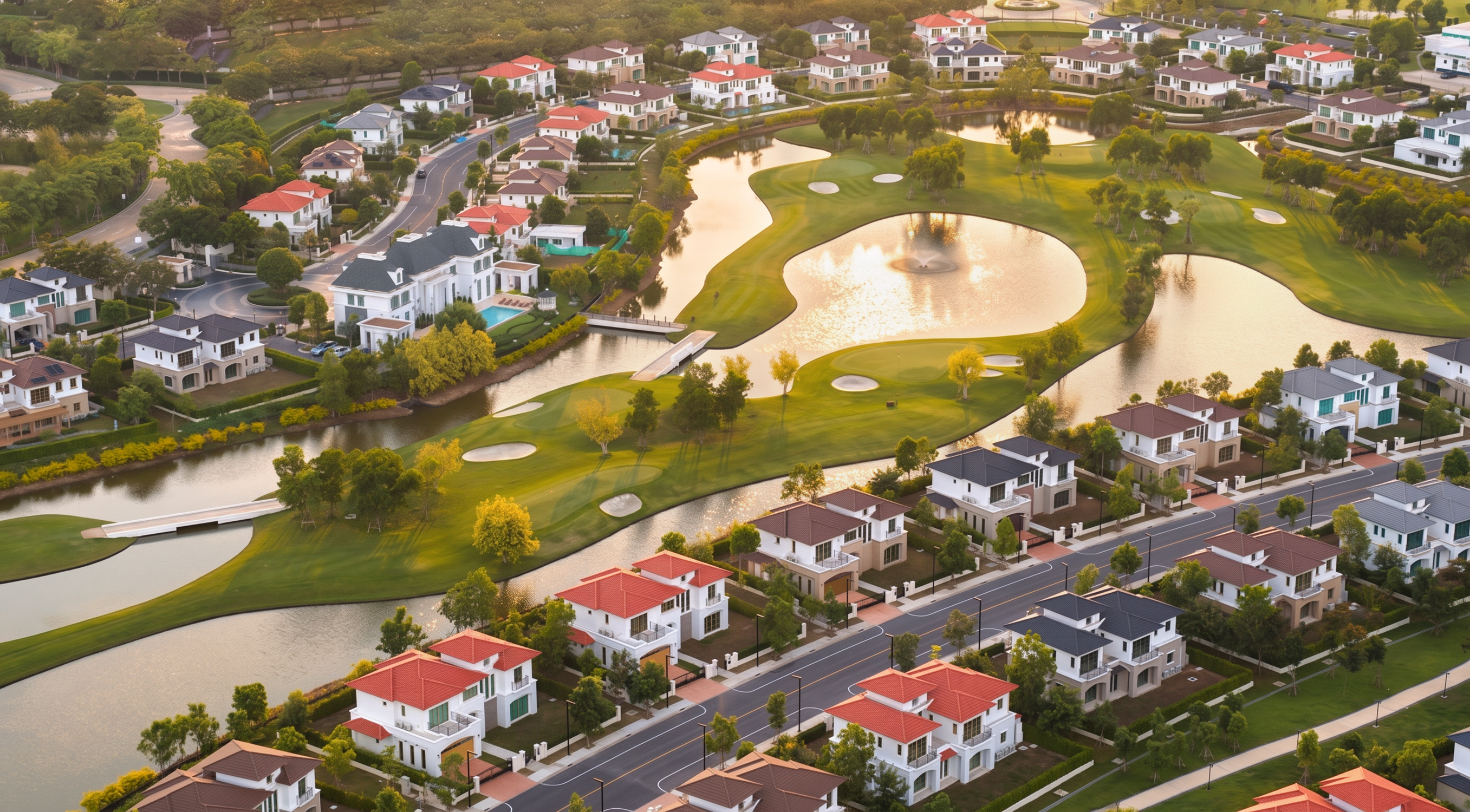
For high-net-worth families, the response has been to price green space into their property decision in a way they previously did not. A 10km walking and cycling track within the development, a golf course of championship quality visible from the front door, and a 2,000-rai (800-acres) footprint of landscaped grounds is not a feature list. It is a different category of home environment.
At Reignwood Park, the green environment is not an add-on. It is the reason the development is where it is. A 2,000-rai (800-acres) site cannot exist inside Bangkok. The choice to build north of the city was the choice to build at scale, and scale is what makes green space genuine rather than decorative.
How the Near-Bangkok Decision Plays Out for Different Buyers
The families choosing to live near Bangkok rather than in it are not a single demographic. The table below maps the specific trade-off each profile is making:
The pattern across all four profiles is the same. What the city centre cannot offer, at any budget, is the combination: land, scale, green space, a golf course inside the development, and an IB school within walking distance. No single facility in Bangkok's centre is absent from this list. What is absent is all of them, together, in one place.
The School Factor: How School Location Is Reshaping Where Families Buy
For families with school-age children, the international school question is often the single variable that narrows the property shortlist fastest. Bangkok has excellent international schools, but they are distributed across the city in ways that create long daily commutes for families in many prime residential districts.
KIS International School Reignwood Park is on a 150-rai (60-acres) campus inside the development, designed by Rosan Bosch Studio, the Danish firm behind some of the world's most acclaimed school environments. The school offers a full International Baccalaureate curriculum from Early Years through Grade 12, with boarding from Grade 4. It is 500 metres from every Reignwood residence.
When the school is 500 metres away, the school run disappears as a logistical problem. Children walk. Grandparents can collect. The family is not coordinating four car journeys before 9 am. This is the practical definition of a complete community, one where the daily friction of city living has been engineered out of the family's routine.
What the Most Complete Luxury Community Near Bangkok Offers
The Reignwood Residence Collection spans three sub-brands across the ultra-luxury segment, each designed for a different family configuration and lifestyle priority:
ESTATE: 41 bespoke mansions on 1.5 to 3 rai (0.6–1.2 acres) plots sited inside the golf course. Construction value from approximately 300 million THB per home. Lifetime Robinswood Golf Club membership, plus private access to the Wentworth Club in London and Pine Valley in Beijing.
SERENO: Luxury single-family homes from approximately 42 million THB. Four design styles, a dedicated SERENO Clubhouse, and three green zones within the sub-community. Lifetime Robinswood Golf Club membership included.
SONIA: Multi-generational family homes designed specifically for households spanning three generations, with layouts built for grandparents and grandchildren under one roof. 30-year Robinswood Golf Club membership included.
Every residence comes with Robinswood Golf Club membership as standard, the third course in Reignwood Group's global golf collection after Pine Valley in Beijing and Wentworth in Surrey, England. No separate membership application. No waiting list. The course is part of the home.
Apart from the membership, every residence will also enjoy the exclusive tuition privileges at KIS International School Reignwood Park, enriching every stage of family life—from world-class education and wellness to an exceptional lifestyle.
City Centre or Near Bangkok: A Practical Decision Table
Before committing to either option, families benefit from mapping their actual priorities against what each location genuinely delivers:
Neither column is objectively superior. The decision rests on how many hours per week the family spends at work in the city versus at home, whether children's school access is negotiable on location, and whether the lifestyle infrastructure, golf, green space, wellness, culture, outweighs the convenience of city-centre density.
How to Make the Decision for Your Family
The clearest framework for this decision is to ask how the family spends its time rather than where it wants to be. Five questions that cut through the marketing language:
- How many days per week does the primary earner commute to an office? If three or fewer, the city-centre premium has no daily justification. Near Bangkok becomes the rational choice.
- Are the children of school age? If yes, evaluate the school-to-home distance at both options. A school 500 metres away ends the commute question for the family's most repeated daily journey.
- Does golf feature in the family's lifestyle? If yes, calculate the real cost of a premium Bangkok golf membership on top of the property cost. An integrated community makes this comparison straightforward.
- Is multi-generational living part of the plan? If grandparents will share the community, walkability, wellness facilities, and cultural amenities matter as much as the primary residence. Near Bangkok delivers these at scale.
- What does the property need to do in ten years? If long-term land appreciation is part of the equation, Pathum Thani's 27.3% year-on-year growth in 2025 reflects the direction of travel for the wider corridor.
Experience the Lifestyle for Yourself
Reignwood Park Thailand is open for tours of the estate, Robinswood Golf Club, KIS International School, and the Reignwood Residence Collection. The golf club and the school are fully operational today. The Reignwood Residence Collection spans three residential sub-brands from SERENO family homes to the ESTATE mansions inside the course, with all construction progress and delivery timelines verified in person.
The most useful thing a prospective buyer can do is spend a morning at the development. Standing on 2,000 rai (800 acres) of operational luxury community north of Bangkok changes the conversation from a comparison of floor plans to a comparison of lives.
Register your interest and arrange a visit at Reignwood Park.